A retrospective of AA Raiba throws light on an internal idyll that never vanished despite life’s hard knocks
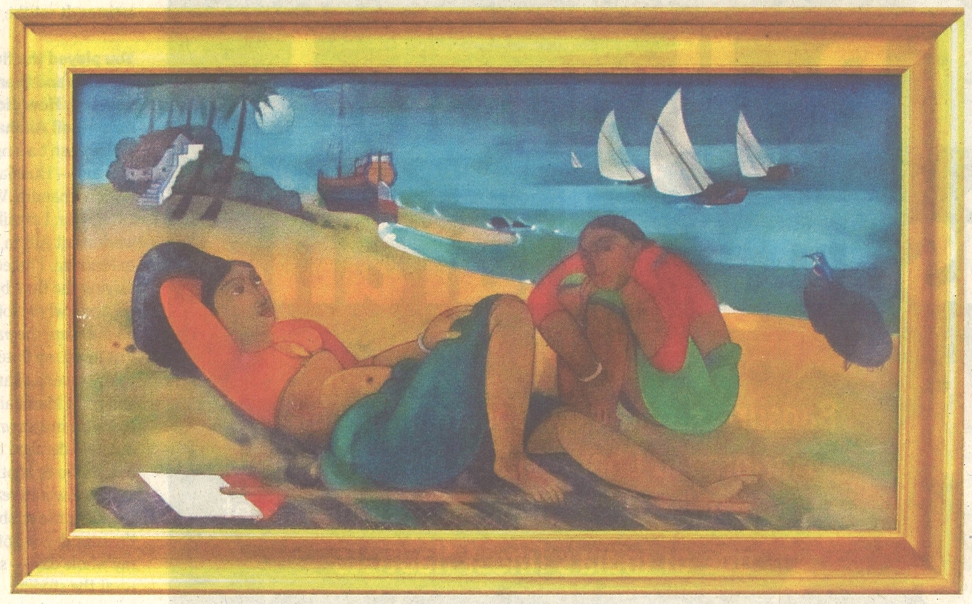
It is a beach in Vasai, a northern outpost of Mumbai in the early ‘80s. The moon has barely risen above the palm fronds that rise above a house in a fishing village. Some fishing boats have set sail in the far distance, while a larger boat is docked on the dunes yonder. Closer to the eye, two women are perched on the sands, not a care in the world. But memory is a chimera too, so don’t bank on it – for if you look closer, one women is lying on the beach in a tropical languor, wistfully looking at the celestial dome above; the other, her sidekick perhaps, is listening to her mentor’s take on the world, her face darkened with a maudlin aura. Their husbands are out at sea, as they are on most days. But when the sea can turn treacherous, one can never tell. And if the purling of the waves in his canvas reveals little of that anxiety, he has captured rather accurately the longing these women feel for their husbands to return. It makes for a hauntingly beautiful work, doubly melancholic for two reasons: the artist was rusticated to Vasai after a financially bad spell in the mid-seventies; and the Vasai in the painting here reflects an idyll that was not defiled by India’s urban juggernaut.
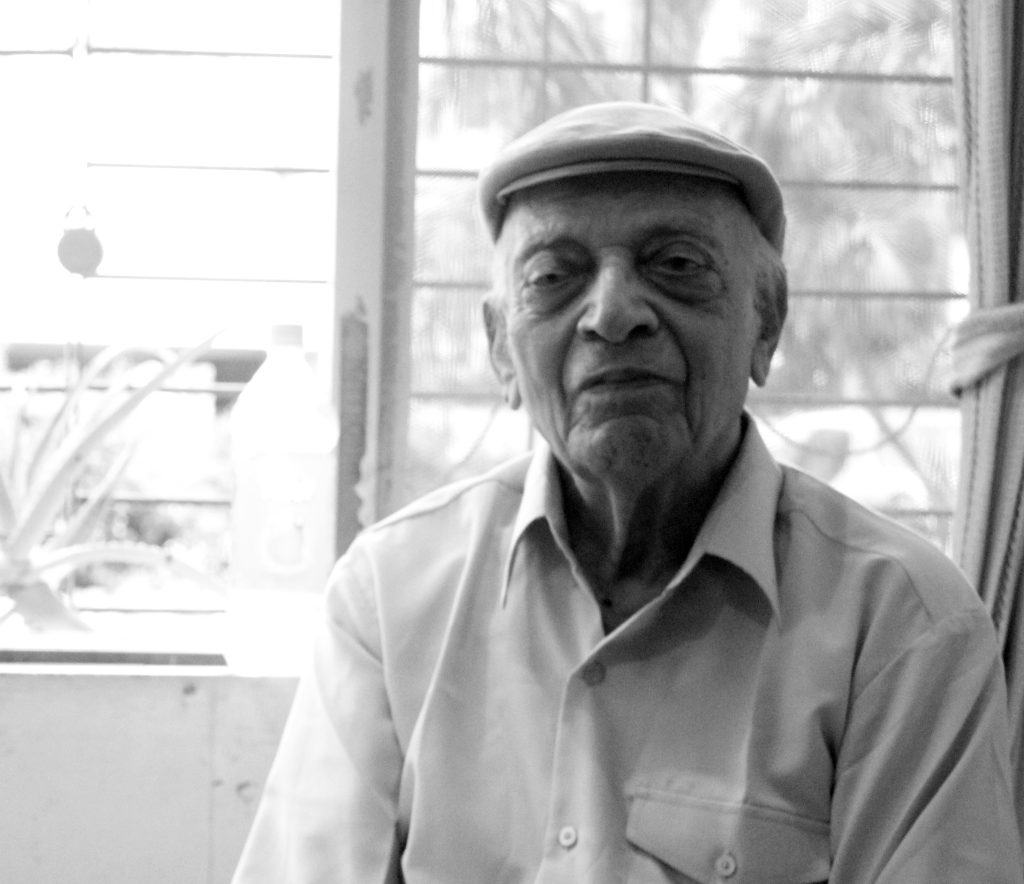
(A A Raiba)
A A Raiba is no stranger to the coast. He comes from a family of Konkani Muslims, a tribe that traditionally worked at Mumbai’s docks and the artist grew up in Temkar Lane near the JJ School of Arts, where Konkani Muslims (once) traditionally lived. That the coast would come back to him via such a tortuous route is sad for an artist who certainly deserved more success than some of his mediocre contemporaries. Yet, being impecunious only made Raiba more promiscuous with his craft (and pray don’t go by the buxom lassies in the image described above). Raiba remains as slippery as an eel when it comes to the methods and mediums he employs. A chequered life has indeed led to an eclectic range of obsessions: the breathtakingly doomed Kashmir valley, where he lived for some years, provided immeasurable inspiration for his landscapes; glass shards went into making portraits of Marathi and Muslim couples reminiscent of the mica paintings from the Company School; paintings on jute and old saris and khadi are unwittingly a reference to having grown up in father’s tailor’s shop; Portuguese architecture and rice fields are a motif for a suburb (Vasai) that existed before Bombay did. Materiality is key to unlocking the treasures of this impressive retrospective. So much so that the sketches in the notebooks that Raiba so obsessively archived are so fragile now that they have had to be digitized into a slideshow, like parchments that need to be preserved at any cost.
Competently curated by Professor Anant Nikam of Sir JJ School of Art and Sumesh Sharma of Clark House Initiative, Miniature to Monumentalism is also commendable given how reclusive Raiba has become over the years. Financial constraints have never been stopped the artist from being prolific, but two things have forced him into a carapace. When younger, there was a bravura that went into putting up a Raiba show. It was the culmination of scholarly research (or his latest thematic or textural obsession), cattily written catalogues (the artist wrote most of his catalogues), self-designed invites (in an era when PR agents only worked for people like Rajesh Khanna). With age catching up, Raiba hasn’t quite had the stamina to pull off the patented tinsel that his exhibitions demand. Secondly, Raiba has justifiably become wary of the art world, ever so teeming with Shylocks from auction houses, fly-by-night operators looking to pick up a work for a few dirhams more, mercenaries who care for neither his craft nor legacy, but can smell an endangered species from Colaba to Nalasopara, a Mumbai suburb where Raiba now resides. The artist is 91.
Reinstating Raiba’s faith in an art world, which began archaeologising his works to its own selfish ends, must not have been an easy task. Also, contexualising 70 years of an artist’s trajectory in such a rigourous and emotional tone is a feat in itself. But most importantly, a retrospective such as this puts forth to the viewer a far more pertinent question: how many artists like Raiba are out there? Is there any hope of excavating them outside of the Raza-Husain smokescreen that auctioneers and galleries throw over? The larger challenge (and hope) that a Raiba retrospective poses to art lovers is how they can potentially reclaim an agency they have lost via the commodification of art.
In a culture that values success and ubiquity (or which certainly equates ubiquity with success) the speculum with which we examine the hidden Harappas of 20th century Indian art needs some serious sharpening. So by all means, a Husain or a Tyeb or a Raza must be the star attraction at the next auction so that demented NRIs and wealthy Indians can buy them and feel good about themselves. They deserve it. But in between obscurity and ubiquity lies a plethora of artists such as Raiba. Their works need not be trussed up at the next auction. They need to be nurtured and presented at heart-warming retrospectives such as these so that the public can engage with a past it didn’t even know existed.
‘Miniature to Monumentalism: The AA Raiba Retrospective’ is exhibiting at the Main Hall Gallery, the Sir JJ School of Fine Art Building, Opp CST Station, Mumbai.